The Hotel St Petersburg was a nine-story monolith built in the 1970s during the period of extensive reconstruction following the Great Patriotic War. The white Moderne-style building filled a long city block. I stayed there while visiting the city. In the mid-1990s it was run as a joint venture with a Finnish company. That’s probably why the breakfast buffet was so memorable, a potpourri of freshly sliced meats, yogurt, cheeses, vegetables, and pastries, supplemented with the ubiquitous buckwheat blini. I had never travelled to Russia during the Soviet era but heard stories from colleagues about a lack of basic services and necessities, a dull gray landscape of blahness and mental fatigue, all tightly controlled by the KGB. During my post-Soviet stays, rooms were drab but clean and well-kept.
The hotel always assigned me to a room on the fifth or sixth floor. You might wonder why I can recall such a trivial detail after more than 25 years, but I suspect the hotel wanted repeat foreign guests, especially those willing to pay in US dollars for the dazzling city views. I enjoyed the cityscape, views of the Neva River and the Aurora, a WW-1 navy cruiser converted into a museum. The seventh through ninth floors were closed to the public. I later learned that a fire had engulfed the upper floors in 1991, a tragedy resulting in the death of several people including two fire fighters. Funds were not available to refurbish the hotel. Furthermore, city streets, public transit, and sewer and water systems were in poor condition. Towering construction cranes seemed to be everywhere, but renovations were probably based on lucky joint ventures or some connection to oligarchs.
I had been warned about drinking tap water from the St Petersburg municipal water supply. Bathing and showering were okay, but brushing teeth with tap water was not acceptable. Drinking the polluted concoction was out of the question. While in Russia, I always drank bottled spring water and scouted nearby convenience stores for additional supplies. The issue became visually apparent on my first visit when I ran water in the tub. I stopped filling it after a few inches and stared at the contents, a light yellow-brown concoction reminiscent of weak Orange Pekoe tea. Even as I write this paragraph, 28 years later, I can see the tub and feel a slight sensation of nausea. I wondered what the locals did, especially those who couldn’t afford bottled water.
My first visit was in late August, three years after the collapse of the Soviet Union. Boris Yeltson was president. The Russian economy had cratered amid chaos after state-owned businesses were divvied up by emerging oligarchs, business leaders under the Soviet system who criminalized entrepreneurial liberalization after Gorbachev. The kleptocratic system was in high gear. Many Russians working in Soviet government enterprises suddenly lost their salaries and had to fend for themselves. Crime increased, and inflation took hold when government price controls were eliminated. It was a tough time to live in the Former Soviet Union.
In early 1994, I was in my office at the Denver Federal Center when Gregory Ulmishek stopped by to ask if I would like to participate in his Russia project, a US Geological Survey joint venture with VNIGRI, a Russian petroleum institute funded in pat by the US Agency for International Development (USAID). VNIGRI is short for: All Russia Petroleum Research Exploration Institute. It was founded in the 1920s as the country’s first research organization supporting the exploration of petroleum. It was currently housed in St Petersburg at 39 Liteyny Prospect. Gregory was a Russian emigre, a knowledgeable, brusque sounding but gentle man, a widely respected petroleum geologist with an international reputation. The US Geological Survey had recently scooped him up to work in the Branch of Oil and Gas Resources.
Gregory needed a project participant with knowledge of petroleum resource assessment and quantitative applications to geologic problems. He said my involvement would focus on comparing resource assessment methods and identifying natural gas resources in deep sedimentary basins using computers and quantitative techniques. At the time, computers and statistics were becoming commonplace in geologic studies. Gregory said he was planning a trip to St Petersburg and the Timan-Pechora basin, and that other Branch scientists would travel to Russia with us: Jerry Clayton, a petroleum geochemist, Ben Law, an expert on unconventional gas resources, and Tom Ahlbrandt, a former exploration geologist and our current Branch Chief. The trip would include conversations with VNIGRI staff in St Petersburg in order to define our research objectives, and a stop at VNIGRI’s office in Ukhta, a city in the Komi Republic west of the Ural Mountains. We would visit important geologic sites in the basin, many requiring a raft trip down a river in a remote national park. Without hesitation, I jumped at the opportunity.
By early September, the five of us had secured Russian visas and were ready to fly to St Petersburg. We had been told to prepare for wet weather and to pack fishing gear. Camping equipment would be provided by our hosts. I’ll get to the fishing part later. We survived two long flights and ultimately checked into the Hotel St Petersburg hoping for an overnight respite from jet lag. The next morning we met the local VNIGRI staff. Michael Belonin, the director, was in his 50s, short and graying. He looked older than his years but displayed a bright smile and gentle temperament. He seemed relaxed, and as I later discovered, was a highly respected and competent scientist. Slaven, his deputy, was tall and always at ease, amiable and self-confident, ready to offer his subtle humor.
We also met Yuri Podolsky and Alex S, both geologists and childhood survivors of the Nazi blockade of St Petersburg. Michael informed me that Yuri and Alex held lifetime public transport passes for surviving the siege of Leningrad as young children. We met others including VNIGRI scientists that would accompany us to the Komi Republic. I was introduced to Olga, Michael’s wife; Katrina (Katya), his daughter, and Sergey, his son in law. Sergey was a handsome man, with strong Slavic features and a significant mustache, seemingly right out of the Cossack cavalry from the Don or Dnieper regions. We spent weekends together on my later trips to St Petersburg visiting museums, shopping, attending concerts, or spending time at one or more dachas. Michael and Slaven were moderately fluent in English. I had memorized several phrases in Russian and tried to comprehend the cyrillic alphabet with limited success. Gregory did double time by translating for us when needed, an exhausting job requiring immense concentration. Gregory clearly had a long cordial relationship with VNIGRI staff. He was respected by all and found badly needed funds for VNIGRI.
We used our free time in St Petersburg to tour the city with our driver and local guide, Alec, enjoying the Hermitage, the former winter palace of the czars, now a museum hosting the works of many famous artists including my favorite Impressionists; the Peterhof Palace, an extravagant response by Peter the Great to Versailles; and several literary, military, and cultural attractions. St Petersburg was a beautiful city but was clearly suffering hard times. The cultural contrast between the extravagant architecture and former lifestyle of the Czars with the ordinary Russian people of the 1990s seemed immense. Most Russians lived in drab, cement slab high rises surrounded by other drab high rises, but the interiors of apartments were well decorated and cared for. My most somber memory of the city was a visit to the memorial to the siege of Leningrad, Piskaryovskoye Memorial Cemetery, where a half million victims of starvation and exposure are buried in mass graves. It commemorates the end of the three-year German siege. Lake Ladoga was the only source of supplies to the city during the 900-day ordeal. During winter months when the lake froze, long truck caravans brought supplies to the city from points east in unoccupied Russia.
St Petersburg had a cash only economy in the mid-90s. No one accepted credit cards. US one-dollar bills were the currency of choice. Businesses were mostly small kiosks or shops, but department stores, supermarkets, bookstores, and restaurants existed too. Everyone feared large denomination counterfeit bills. On several occasions, I waited patiently while cashiers tallied 50 or more greenbacks in bill-counting machines. Five- and ten-dollar notes, when accepted, were exhaustively scrutinized. No one seemed to want rubles. Finding a simple restaurant meal was a troublesome activity. The selections were limited to a fancy seven course meal with live music and scantily clad waitresses, or fast food. I chose fast food, usually another joint venture with a western European company. I often ate at McDonalds. It had recently opened and was spectacularly popular with locals.
The slow painful shift to private enterprise had begun. St Petersburg had an efficient and well-run subway system with beautifully designed stations. Often poor pensioners would hawk their wares in the underground stations to make a living. On one occasion, I purchased a Russian stamp collection and a bag of Russian military memorabilia for a few dollars each at a subway entrance. I witnessed a babushka (older Russian woman) attempting to hawk a tire, and commuters chasing young gypsy children after an attempted theft. We were warned about the gypsies. Wealthy Russian men were easy to spot because they were surrounded by several thuggish-looking body guards scrutinizing the surrounding area for potential assassins. It was clearly a sad and embarrassing time of economic chaos, crime, and uncertainty.
On a later visit to St Petersburg, while in my room late one evening, I heard steps in the outer hallway and then noticed my door knob turning as if someone was trying to enter my room. I had securely locked the egress, but for good measure I moved a couple of stuffed chairs and writing desk in front of the door. For the most part, I felt safe in St Petersburg, but I was always vigilant.
Michael Belonin had booked flights for our group to Ukhta, a small city of 80,000 nestled in the boreal forest (or Taiga) of the Komi Republic 1,000 miles east of St Petersburg. Our flight was uneventful but our Aeroflot TU-154 airliner started vibrating severely during the final descent into Ukhta. I could only see gray from my rain spattered window and nervously looked at Michael and Slaven seated nearby. They were chatting away, seemingly unaware of the agitated surroundings. My tray top suddenly dropped into my lap as I looked out the window again and finally saw the runway a few hundred feet below.
Ukhta was a remote but fascinating metropolis, a bustling burg of high-rise buildings. It seemed small in size because it was. Our hotel was situated in an unmarked building near the city center. We were escorted to our upper floor rooms and told to meet later in the lobby for dinner. The view from my window looking down at the city center and beyond was amazing. The sun finally appeared late in the afternoon, but the landscape was still a mass of dull Soviet-style buildings. There were few vehicles, some busses, mostly military style delivery trucks. The streets and walkways were frenetic, a teeming mass of humanity walking here and there. Billboards or signs indicating businesses were nonexistent, no marquees or brightly colored lights, nothing resembling capitalistic ambience. The view beyond the cityscape was one of green tree covered hills, a forest canopy of spruce, fir, aspen, and poplar.
When we met in the lobby and walked to our restaurant that first evening, the sun was still well above the horizon. The White Nights of the summer solstice had ended but at 65 degrees north latitude, just below the Arctic Circle, the sun would still not set until 10 or 11 PM. I imagined winter would be cruel here. Our group walked the few blocks amid stares from local pedestrians. I doubted Ukhta saw many outsiders, especially western-looking strangers. It was clearly not the center of international tourism. We followed Michael and Slaven into an unmarked doorway, up a set of stairs, and into a very pleasant, well-furnished dining room. There, we focused our attention on Ukhta-style steak frites.
The next morning, we visited Ukhta VNIGRI, housed in a low-rise building on the edge of the city and were introduced to Yuri Bigotsky, a senior petroleum geologist. He gave lectures on petroleum geology, Timan-Pechora basin exploration and production, source and reservoir rocks, and the geologic story of the Ural Mountains. We met Yuri’s wife, Anna, an ethnic Komi and highly educated intellectual willing to share her perspectives on current Russian problems. She was fluent in English and willing to talk about anything, politics, economics, western society, the Stalin era purges, anything. Anna and another Ukhta VNIGRI spouse would accompany us on the raft trip. Anna would function as an additional translator and assist in cooking for our expedition. I had conversations with Anna about the current state of Russian society and her hopes and fears about the future. We were all very fond of Anna.
The next day we visited a quarry west of the city to view and sample the Domanik Shale, a widespread Devonian petroleum source rock. On the drive there, one of our VNIGRI hosts (probably Anna) pointed to deeply weathered ruins of lookout towers and structures half hidden in the trees near the road. These were the remains of one of Stalin’s many gulags where prisoners were fated to work on huge construction projects under primitive conditions with little food or care. Throughout the Soviet Union, millions of gulag inmates died of starvation, exhaustion, disease, or were shot by guards. That was a sobering thought. I had studied history, read Solzhenitsyn’s book, and wondered what projects near Ukhta involved gulag internees. It was becoming clear to me that a dominant Russian cultural trait was the acceptance of adversity, a tendency for dark humor, and the resilience and resourcefulness associated with a long history of totalitarianism.
The Domanik was deposited on the floor of the Panthalassic Ocean during a time of global anoxia potentially caused by intense volcanism, an impact structure, or maybe both. The Panthalassa was a super ocean surrounding a supercontinent, Pangea. The world ocean of the Devonian was starved of oxygen, preventing oxidation and the destruction of rotting organic matter, the remains of plants and animals. Mass extinctions were common, and vast amounts of organic matter accumulated on the sea floor. These organic-rich sediments were buried and thermally altered into rich oil and gas resources worldwide. Devonian organic rich shales are ubiquitous. They are found today in the eastern US resulting in highly productive oil and natural gas horizons. The typical global range of organic carbon in petroleum source rocks ranges from about 1-5 percent. The Domanik is far richer, up to 30 percent organic carbon in some localities in the Timan-Pechora basin. The gas-rich reservoir rocks on our forthcoming raft trip were mostly sourced by the Domanik.
Our next stop was a nearby oil mine. Typically, wells are drilled vertically and then often horizontally, and oil is pumped to the surface, but here, oil is seeping to the surface. Seeps were first identified in the Ukhta area in the 18th century and later, oil was mined commercially. We arrived at the production facility and entered a tan brick building where we were given heavy burlap coats, orange hard hats with battery charged lamps, knee high rubber boots, masks, and oxygen canisters. Before heading to an outdoor elevator shaft, a safety demonstration and tour instructions were provided by our local host, the mine foreman. After noisily descending a few hundred feet, the elevator door opened into a large brightly-lit shaft. The overhead lights revealed a fascinating sight, one of walls oozing high viscosity crude. The sweet smell of hydrocarbons was evident even at a cool 50 degrees, a hazy combination of rotten eggs and fuel oil, a toxic aromatic mixture at high concentrations. Our guide pointed to rock fractures along the walls, the source of the black seeping liquid. The oil slowly drained downward into troughs along the shaft margins and into a reservoir where it was pumped to the surface.
We were standing on the floor of a 20-ft-wide horizontal well gazing at a limestone reservoir rock inexorably draining its bounty. I was impressed. It must have been a tremendous effort to excavate the mine. Where did the produced oil end up? When was the shaft excavated? Our host said that a Parisian cosmetics company used some of the oil to make perfume. Was he joking? Suddenly, a thought occurred to me, about the tremendous amount of human labor required to excavate this mine in the early 20th century in such a remote setting. We were in the bowels of a Gulag achievement, a manifestation of pain and suffering, the product of countless prisoners slaving away to make perfume for Parisians. I doubt the oil was actually shipped to France during Stalin’s reign but, who knows, the thought was still frightening.
The next day, we flew to the municipality of Vuktyl, near the western edge of the Ural Mountains. The Urals are a fascinating range, splitting the Eurasian continent in two. The area to the east is generally considered part of Asia. The range is more than 2,000 miles long and formed 300 million years ago during the Pennsylvanian Period when several small continents collided to form Laurasia, the northern part of the supercontinent of Pangea. The Urals are also one of the richest mineral provinces in the World, and we were there to observe the Paleozoic limestones, and to fill salt-filled wooden barrels provided by our Russian colleagues.
Vuktyl was a community at the end of the line, a production hub for natural gas in the Timan-Pechora basin, situated along the banks of the Pechora River, 150 miles east of Ukhta, just below the Arctic Circle, a place that saw little winter sunlight. From the Vuktyl airport, isolated communities, petroleum installations, and occasional raft trippers were served exclusively by helicopter. Our final leg was delayed due to poor visibility, so we sat around the spartan air terminal cafeteria drinking hot sweet tea from glasses. Suddenly we were ushered outside as visibility improved and rain dissipated. We were headed to the Shchugar River in Yugyd National Park. The park had been established earlier in 1994. As a matter of comparison, Yugyd is the largest national park in Europe at more than 8,000 square miles, more than twice that of Yellowstone.
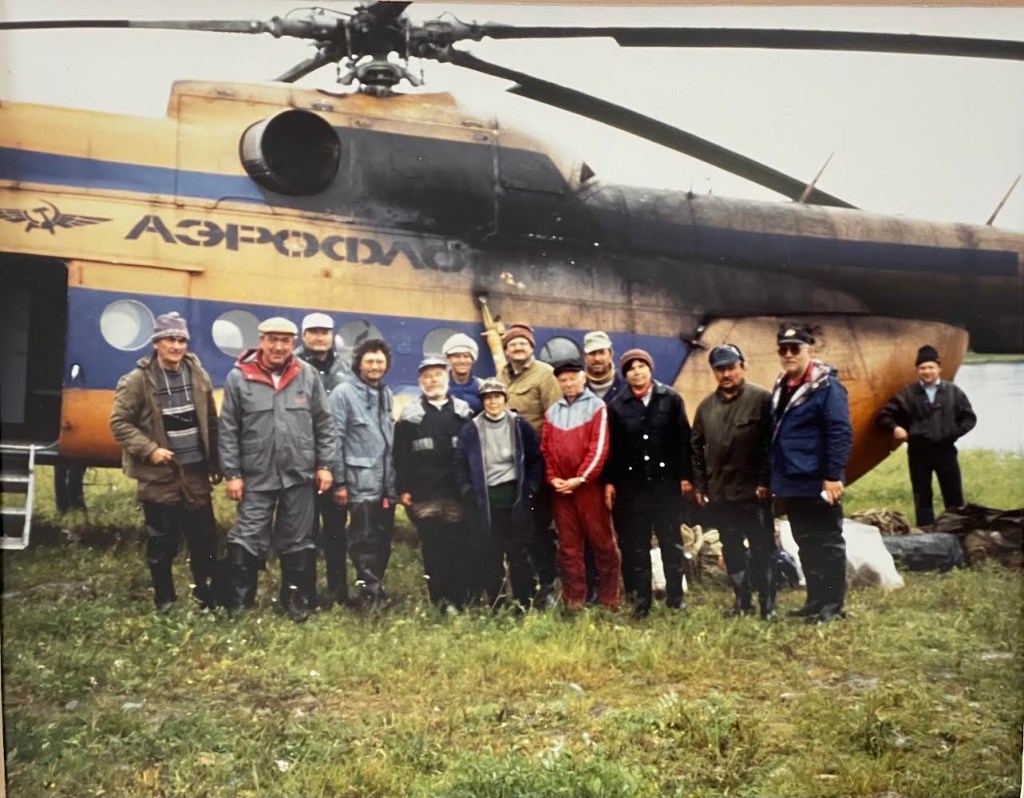
I had never flown in a helicopter. The lack of aerodynamics in rotary flight has always troubled me. The current fog, rain, and low visibility didn’t help much either. We walked toward the largest helicopter I had ever seen, a yellow and blue diesel-powered behemoth. I noticed the blackened exhaust ports, not the cleanest looking airborne transport vehicle. We loaded our gear into a cavernous compartment under the guidance of the copilot, simply piling everything, rafts, cooking gear, tents, sleeping bags, barrels of salt, into the large open space. There were no windows, seats, or seat belts, just blue metal plating everywhere. I situated myself on a soft spot between two large duffel bags and waited for the takeoff, then noticed a black rubber hose strung across and through the top of our luggage, threading its way forward, ultimately disappearing into the wall near the cockpit. Ben and Jerry noticed it too, then Gregory. It seemed important, so we pointed this out to the captain when he walked back to check on us just before takeoff. Gregory shrugged, then smiled after translating two words—fuel line. Was he kidding? The roar of the engine, intense vibrations and sudden lift did nothing to stem my concern. We were in the air flying low over the countryside on our half hour flight to our destination.
The landing was surprisingly smooth. When the door finally opened and we stepped outside, we found ourselves standing on a gravelly, high-water river terrace, next to a 300-ft-wide stretch of pristine watercourse in a forested mountainous terrane, not the mountains of Colorado, but more like the eastern ranges of the US. It was a picturesque setting, a remote subarctic arboreal scene, even with the overcast sky. Our pilots were in a hurry to leave because of decreasing visibility, so we quickly unloaded our gear and bid them farewell. We were scheduled to rendezvous in 6 days at a site 50 miles downstream.
It started to drizzle. As our Russian hosts set up tents and a cooking-dining area, we donned our rain gear, posed for some celebratory photos, and prepared our fishing lines. I rummaged through my tackle bag, snatched an Eppinger Dardevle, that characteristic red and white spoon, and was the first to cast into the fast-moving current. Ben, Tom, Gregory, and Jerry quickly followed suit. The Russians watched expectantly as we cast into the stream. I immediately had a strike and reeled in a 10-inch Arctic grayling. Everyone caught a fish on their first cast. There were cheers from the cooking area. Was that just a fluke? Were the fish starving? Was this real? I cast again and again, and each time snagged a grayling in the 8-14-inch range. I’m not exaggerating. The others were pulling them in too. It was an assembly line project. In a preliminary effort at international cooperation, the Americans fished while the Russians cleaned and fried the unlucky aquatic critters. Within 30 minutes, dinner for 10 hungry geologists was in the preparation phase, pan fried grayling and various side dishes. Only once, in the 1960s as a young angler, did I experience a similar opportunity. My brother and I caught trout at a private fish farm in Illinois, but we only kept a few of the starving rainbows because the cost was defined by weight, but now, there were no restrictions, no licenses, the sky was the limit.
After dinner, Valentin, disappeared into the damp forest, reappearing 10 minutes later with a handful of local herbs, various unidentified leafy tea ingredients, black current leaves, chamomile, and mint. He dropped the bouquet into a large pot of boiling water, and we watched the brew simmer, waiting for our post dinner beverage. The Russian people have always been close to nature. Nearly everyone I met there had a small garden, fished the local streams and lakes, gathered mushrooms, or professed the use of herbal medicines. Many owned a small dacha, a country home or cabin. On one occasion during a subsequent visit a year later, I visited Michael Belonin at the high-rise apartment he shared with his wife, Olga, in St Petersburg. The living room was full of drying screens covered with their harvested mushrooms. On another occasion, during a visit to Slaven’s dacha somewhere north of St Petersburg, his luncheon table hosted several plates of his home-grown herbs, including parsley and dill that were served with lunch.
The next morning arrived, sunny and clear with a heavy coating of dew, a result of yesterday’s rain. Everyone was starving. We were always starving. I suspect that was due to our healthy cuisine, active lifestyle, and natural setting. Breakfasts were simple, usually a pot of buckwheat cereal, canned milk and butter, and maybe some fish leftover from dinner. Once or twice, our porridge was supplemented with buttered bread and caviar. I craved the dense white bread. Buckwheat has been a dietary staple of Slavic societies for a thousand years. The carbohydrate and protein rich cereal (called Grechika or just kashi) was ubiquitous there. Actually, buckwheat is not a wheat, but a pyramidal shaped seed from a plant in the Rhubarb family. I even remember my Polish grandmother’s blood sausage (kiszka), a concoction of pig’s blood and a filler, that may have been buckwheat.
During breakfast, our guide (seemingly the only ranger for several thousand square miles of national park) appeared in his tiny, dilapidated one-person raft, ready to guide us downstream for the first few days. We were informed earlier by our Russian hosts to bring US dollars for him as a gratuity. He looked much older than his years, a short, spare leathery fellow, very friendly and animated, although we didn’t understand what he said unless Gregory or one of our bilingual hosts intervened. I wondered where he lived between raft trips and routine patrols in this vast roadless forest.
Our downstream descent had started, and we settled into a daily routine of floating the river, observing the geology, fishing, eating, and bantering with our Russian hosts. It was an amiable group. We weren’t glamping by any means, and were often wet or damp, but no one complained while we waited for a warm fire late in the day. Luckily, Valentin brought a petrol product to ignite wet kindling. The Shchugar was a moderately swift stream, wide and shallow, with numerous exposed sandbars and a low gradient meandering channel punctuated by gentle, widely-spaced rapids. We regularly stopped to observe rock outcroppings, mostly limestones exposed along cutbanks. A typical stop, often for lunch or to view an outcropping of significance, included a lecture by Yuri Bigotsky, some head scratching, and the gesticulation of interpretations. Often, there were disagreements, arm waving, some boisterous arguments in Russian, then laughter. Gregory was extremely skilled in literal translations. It became clear to us that the Timan-Pechora and other less explored Russian basins, especially those in the Arctic regions, held tremendous petroleum potential.
By day three, the salted barrels began to fill. No one complained about eating grayling for dinner. Anna and Valentin were excellent outdoor chefs. They prepared our favorite, pan-fried grayling, but also fish stew, fish soup, and just raw salted grayling. I wasn’t particularly motivated by raw fish, but my enthusiasm intensified when we were shown cans of a notorious Russian beef product, half kilo tins the size of a Spam container that would be opened if fishing proved unproductive. Thankfully, we never had to eat the beef.
I intended to return to the USA with several cans of roe and asked about the best Russian product to select. My inquiry was followed by an animated lecture from Slaven concerning the preponderance of substandard caviar flooding the St Petersburg market. Slaven seemed to know his caviar and later sent me home with the best available products. He showed me two identical tins when we returned to St Petersburg. They looked exactly alike to me, black with a sturgeon image and some cyrillic lettering. I never understood why one can was a cheap imitation of a respected brand, a result of the chaotic markets of post-Soviet Russia, but I explicitly trusted Slaven. I brought home four or five tins of the delicacy based on his recommendations. Slaven seemed to be an expert on Russian vodka too. He explained which brands to avoid, toxic distillates he described as poisonous, brands sold for next to nothing and consumed by alcoholics. It was widely known that alcoholism was widespread in Russia.
I don’t remember exactly when our guide left us, but before he did, we tipped him generously and left him with some of our fishing paraphernalia, mostly lures and fishing line, stringers, hooks and lead sinkers, a few reels, and plastic wormy attachments. I had never seen a more thankful recipient. We bid him farewell, and he paddled upstream.
By day five, rain showers became more frequent, and the Shchugar started rising noticeably. Michael Belonin shared his concern about our return flight to Vuktyl the next afternoon because the helicopter pickup point was close to the river bank. But we were on schedule happily floating our way downstream. We were scheduled to spend our last night at a rustic log cabin near the site. It was an idyllic scene, a weathered wooden shelter in the dense woods, a peasant abode but glamping to me, rough wooden interior furniture, very welcoming. We shared our last piscatorial feast there, grayling of course, and caviar with blini! Fortunately, with a hard-sided roof over our heads, the continuous late-night rain wasn’t an issue, although I developed a sore throat, and a pesky cold seemed imminent—a small inconvenience for such a delightful week-long experience.
The rain had stopped by morning of day six, but the river continued to rise. The area was saturated. We had piled a small mountain of equipment next to the nearby landing site and watched the river rise as we waited for our evacuation. Around noon the familiar chop-chop of rotor blades approaching from the west was heard, and we waited for our pilots to land. We loaded our gear and posed for a group photo, a gaggle of grimy unshaven geologists. In Vuktyl, we said goodbye to our Ukhta colleagues who departed on a different flight. We would see them again.
Our return trip to St Petersburg included a brief stop in Syktifkar, the capitol of the Komi Republic. There we transferred our luggage to a security area where an older male attendant, a diligent geezer wrapped our luggage in white butcher’s paper. Each piece of luggage was carefully sheathed and fastened in twine, stacked and loaded onboard for our flight to St Petersburg. We were informed that it was for security reasons to protect our luggage from pilfering. It looked to me like another make-work project. I willingly handed over a few bills and waited to board our flight.
Back in St Petersburg, Michael, Yuri Podolsky and I finalized our project goals. Our goals were to identify and geologically describe deep sedimentary basins in the Former Soviet Union and select those with a potential for yet-to-be-discovered natural gas resources—which meant the potential below 15,000 feet. We would also compare and contrast our different methods for assessing undiscovered oil and gas resources. The project continued for the next four years. We visited each other in both Denver and St Petersburg several times, shared geologic information, presented our results at meetings, and prepared manuscripts for publication.
Gregory’s project was active during a time of change and uncertainty in Russia, a period of systematic socioeconomic failure. As I look back at my experience in Russia a generation later, I can’t help but feel a profound sadness, a missed opportunity of what could have occurred in such a rich and diverse country, a cultural collage spanning 11 time zones. Unfortunately, the overwhelming reality of Russian history, a Czarist feudal system, a one-party socialist state under Lenin, the horrors of Stalin, and the dull, gray totalitarian Soviet state all left an indelible mark on the Russian people. Today, the country is again in a sad state, a floundering nation run by a murderous nuclear-armed dictator backed into a corner by his despotic ambitions and his distorted need for a place in history. Half the population depends on the government for social and financial security, living a life just above the poverty line. The Russian response to the course of history seems to be: “Keep your head down and work around the system when you can, otherwise things will get worse.”
One of my many conversations with Anna still sticks to me. She said the Russian soul was built on surviving tragedy, long periods of war, social chaos, poverty, living lives of quiet desperation. Noone knows what the future will bring.
 THADDEUS DYMAN