According to vocabulary.com, the word ephemera was originally used as a medical term for an illness or health event that lasted one day. The word later evolved to mean anything that lasts a short time, maybe a day or maybe just a second. It might refer to anything, the very short life of mosquitoes, a rainbow, meteorological events such as tornados, an eclipse of the sun, a headache, or the short life of paper memorabilia. The term is used in the sciences for processes, events, or structures known to occur over a short time and then disappear. A strong thunderstorm may deluge an arid river basin, but the basin reverts to its former parched self in a matter of days or weeks. Here today, gone tomorrow, as the saying goes. Life is ephemeral. But in geology when deep time is invoked, a short time may be a hundred thousand years.
Armored mudballs were on my geologic bucket list for years. I read about them and envied those who had seen the rare ephemeral structures, both modern short lived mudballs and (if one is very lucky) their rare fossils preserved in rocks from the deep past. They form as clumps of clay rich mud that fall from over steepened river banks or coastal cliffs and roll downstream in flowing water, rounding as they continue their sticky rolling journey and acquiring armor as sand and gravel press into their soft exteriors. When a river bed dries, mudballs dry too and soon break apart. They can vary in size but rarely exceed 10 centimeters in diameter. They are very delicate structures. Fossilization of a mudball in a sedimentary rock is an even rarer event.
I was on the lookout for armored mudballs while driving west on Utah highway 12 in high desert plateau country. There is a drainage divide along the route at a place called The Blues. It separates Upper Valley Creek on the northeast from Henrieville Creek on the southwest. The Blues is appropriately named. It’s a an upland area with deeply incised canyons comprised of the Late Cretaceous Kaiparowits Formation, a blue-gray clayey shale unit that formed when rivers flowed through the region 75 million years ago. It’s known for its prolific collection of aquatic and terrestrial fossils including duckbill dinosaurs, crocodiles, and turtles. I’ve looked for fossils in the Kaiparowits on several occasions and have snagged snails, clams, and a few reptile bone fragments. Because it’s so clay rich, walking on the Kayparowits can be grim business when the unit is wet, but it’s a potential source for armored mudballs as headwaters of Henrieville Creek erode sticky mud from the Kaiparowits.
I parked off the highway at a viewpoint on the pass and looked around. Farther uphill away from the divide, the Kaiparowits loomed, more than a thousand feet of shale beds exposed along a steep slope. Thin interbedded sandy layers define river channels that meandered through the Kaiparowits floodplain. I was tempted to hike into those beds, but it’s a long way down to the valley below, a dangerous venture for exploration. As I looked around, I could see that the Kaiparowits contributed shale debris to the drainages, probably during summer storms, and large chunks of it were everywhere. The uppermost reaches of the plateau above the shales were veneered with more recent Ice Age debris, long travelled resistant pebbles and cobbles, rounded and polished by meltwater from alpine glacial ice. I suspected this was an ideal environment for mudball formation. I would give it a try.
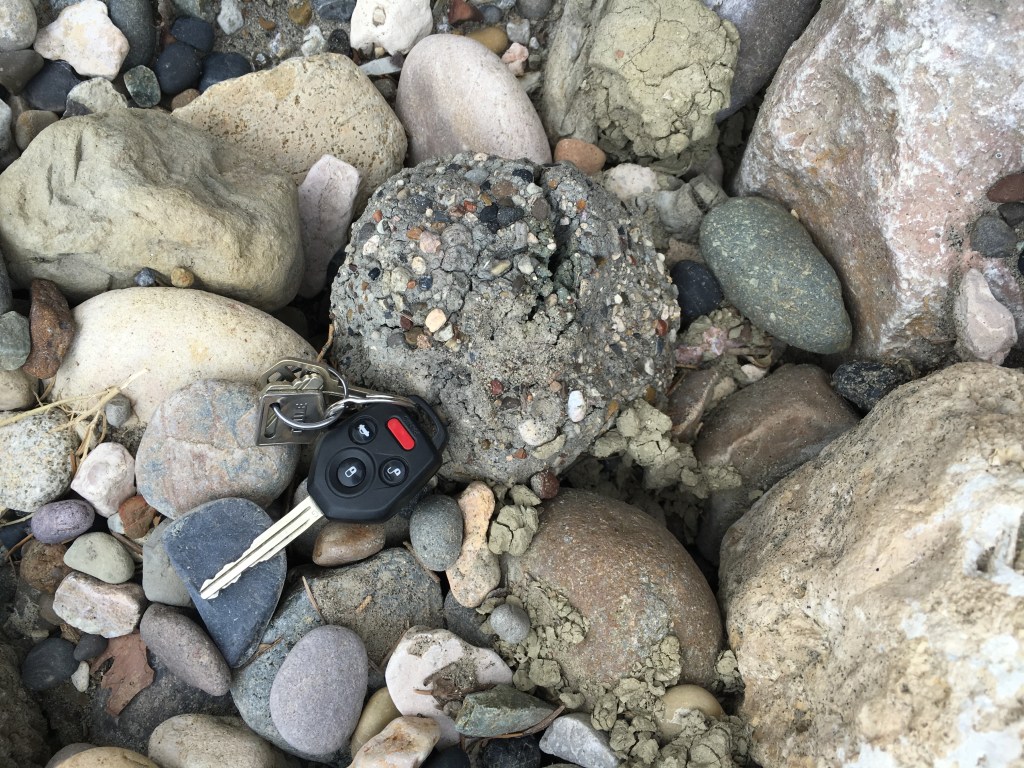
I had an easy path downhill into the upper reaches of a dry tributary to Henrieville Creek. Clumpy shale and polished pebbles began their descent here. I didn’t have to walk far. Along the creek bottom sat a near perfect mudball, then a few more in various states of decay, all veneered with gravel from the creek bed. The finest one, nestled between an assortment of multicolored pebbles and cobbles, was lodged there waiting for its impending doom. It was speckled blue, nearly spherical in shape, impregnated with sand and pebbles, and beginning to show cracks, but still an outstanding example of an ephemeral structure. It probably began its short life just below the road during a thunderstorm a day or two earlier. I was in mudball heaven.
My wife’s nephew, Jon, and his wife Mayumi, live off the grid near Lamy, New Mexico, on an acre of high desert scrub nestled against a south facing cliff face comprised of Ice Age gravels. Jon and Mayumi are artists. Jon is a also a collector of ephemera like me, of fossils, rocks, and geological and cultural curiosities. He has a prodigious collection of artifacts due partly to the previous property owner, also a collector who had left his collectables in place when he left. I was duly impressed by Jon’s polished beach pebbles, mammal bones, concretions, and fossil wood. Jon has one of the most interesting back patios I’ve ever seen, a potpourri of earth history.
On a recent visit, I noticed an object that astounded me. I delicately held it in my hand out of deep respect. It was a lithified sphere with a gravelly outer coating, clearly a fossilized armored mudball. I’ve seen a lot of stuff in my 50 years working as a geologist in the field, but this discovery was emotional. Jon told me it was a gift from a friend, and was most likely sourced in a river bank south of Santa Fe. Wow! Excitement is contagious. Jon and I had an animated conversation about natural art and geologic structures. I looked up at the gravelly cliff behind his house and wondered if those fossilized river beds might have some mudballs too.
After visiting Jon, I checked online for publications dealing with armored mudballs. There aren’t many posts, but Richard Little, a retired geology professor has found them in Jurassic rocks in western Massachusetts. He’s been trying to garner support to establish them as the official State Geologic Structure of Massachusetts. I’ve heard of state birds, dinosaurs, flowers and trees, but not geologic structures. I’m happy that others are as excited by armored mudballs as I am.
 THADDEUS DYMAN